Sunday, 11 June 2017

Lullaby: Google's New C++ Libraries For VR/AR

Google's newest open-source project is called Lullaby.

Lullaby is a set of C++ libraries designed for developing VR (virtual reality) and AR (augmented reality) games/applications. These libraries are designed for high-performance VR/AR, supports full 3D VR environments, provides a common set of widgets and a complete animation system, a Java-based API for integrating with Android apps, and is used by many teams in Google. Android, iOS, Linux, and Windows are fully-supported.

Among the teams at Google already using Lullaby are VR Home, the Play Store, YouTube, Play Movies, and Google Earth.

More details on Lullaby via

GitHub

.


Read the full article here by Phoronix

Docker's LinuxKit Launches Kernel Security Efforts, Including Next-Generation VPN

darthcamaro writes: Back in April, when Docker announced its LinuxKit effort, the primary focus appeared to just be [tools for] building a container-optimized Linux distribution. As it turns out, security is also a core focus -- with LinuxKit now incubating multiple efforts to help boost Linux kernel security. Among those efforts is the Wireguard next generation VPN that could one day replace IPsec. "Wireguard is a new VPN for Linux using the cryptography that is behind some of the really good secure messaging apps like Signal," said Nathan McCauley, Director of Security at Docker Inc. According to the article, Docker also has several full-time employees looking at ways to reduce the risk of memory corruption in the kernel, and is also developing a new Linux Security Module with more flexible access control policies for processes.
Share on Google+

Read more of this story at Slashdot.


Read the full article here by Slashdot

Intel Threatens to Sue Qualcomm over Windows 10

Intel published a blog post earlier this week concerning x86's upcoming 40th anniversary, and one portion, "Protecting x86 ISA Innovation," includes veiled warnings to Qualcomm and Microsoft concerning their ARM collaboration: "...there have been reports that some companies may try to emulate Intel's proprietary x86 ISA without Intel's authorization." It seems obvious that Intel is unhappy about Windows 10 PCs running Snapdragon 835 chips with x86 emulation, and some think an epic legal battle may be on the way if Qualcomm doesn't agree to licensing. This author opinions that the true purpose of Windows 10 on ARM is ensuring the PC market is not hamstrung by an Intel monopoly. "Intel carefully protects its x86 innovations, and we do not widely license others to use them," the post continues, suggesting two things. That Qualcomm has not licensed Intel's "x86 innovations." And that Intel isn't particularly inclined to do so, given that Qualcomm's entry into the PC market will negatively impact Intel's already-falling PC chips sales. Furthermore, Intel has aggressively pursued those companies that do violate its intellectual property. And it isn't shy about reminding us of the results. "Over the past 30 years, Intel has vigilantly enforced its intellectual property rights against infringement by third-party microprocessors," the two explain. Discussion

Read the full article here by [H]ardOCP News/Article Feed

Friday, 9 June 2017

Mozilla's WebExtensions APIs allow for cross-browser extensions in Chrome, Opera, Firefox and Edge

Creating add-ons for multiple web browsers can be a nightmare for developers, but Mozilla wants to simplify things. By introducing WebExtensions APIs it is going to become much easier to make extensions that work in multiple web browsers with only minor changes. Based on HTML, CSS, and JavaScript, the aim is to further standardize the APIs to make it even easier to share extensions between browsers. Mozilla is now pushing the technology in the hope that it will gain momentum and a growing following. In a post on its Hacks blog, Mozilla explains that WebExtensions enables developers to "write one… [Continue Reading]


Read the full article here by Betanews

Tuesday, 6 June 2017

Four short links: 6 June 2017

P2P Browser, Learning RTS, Growth Hacking, and Apple's ARKit

  1. Beaker Browser -- A peer-to-peer web browser. Create and fork websites directly from your computer. You control your data. No blockchain required.
  2. TorchCraft -- a library that enables deep learning research on real-time strategy (RTS) games such as "StarCraft: Brood War" by making it easier to control these games from a machine learning framework—here, Torch. This white paper argues for using RTS games as a benchmark for AI research and describes the design and components of TorchCraft. Code on GitHub.
  3. GrowthHackers Conference Notes -- notes from all the sessions on the recent GrowthHackers Conference.
  4. Apple ARKit -- augmented reality framework for iPhone and iPad. I'm looking forward to their hardware entry, for which this greases the runway.

Continue reading Four short links: 6 June 2017.


Read the full article here by Four Short Links - O'Reilly Media

A Look at Eevee: Blender's Realtime Rendering Engine

It looks like you're using an ad blocker! I really need the income to keep this site running.

If you enjoy BlenderNation and you think it’s a valuable resource to the Blender community, please take a moment to

read how you can support BlenderNation

.

A Look at Eevee: Blender's Realtime Rendering Engine

0

Remington Graphics takes a look at Blender's new Eevee engine, and specifically at the PBR capabilities.

VIDEO

About Author

Bart Veldhuizen

I have a LONG history with Blender - I wrote some of the earliest Blender tutorials, worked for Not a Number and helped run the crowdfunding campaign that open sourced Blender (the first one on the internet!). I founded BlenderNation in 2006 and have been editing it every single day since then ;-)


Read the full article here by BlenderNation

Sunday, 4 June 2017

Chrome To Deprecate PNaCl, Embrace New WebAssembly Standard

An anonymous reader quotes Tom's Hardware Google announced that its Portable Native Client (PNaCl) solution for making native code run inside the browser will be replaced by the new cross-browser web standard called WebAssembly... Even though Google open sourced PNaCl, as part of the Chromium project, Mozilla ended up creating its own alternative called "asm.js," an optimized subset of JavaScript that could also compile to the assembly language. Mozilla thought that asm.js was far simpler to implement and required no API compatibility, as PNaCl did. As these projects seemed to go nowhere, with everyone promoting their own standard, the major browser vendors seem to have eventually decided on creating WebAssembly. WebAssembly can give web apps near-native performance, offers support for more CPU features, and is simpler to implement in browsers and use by developers.
Share on Google+

Read more of this story at Slashdot.


Read the full article here by Slashdot

Friday, 2 June 2017

Germany Detects Emissions Cheat Software In Audi Models

The German government has accused Audi of cheating emissions tests with its top-end models, marking the first time the company has been accused of such wrongdoing in its home country. Reuters reports: The German Transport Ministry said it has asked Volkswagen's (VOWG_p.DE) luxury division to recall around 24,000 A7 and A8 models built between 2009 and 2013, about half of which were sold in Germany. The affected Audi models with so-called Euro-5 emission standards emit about twice the legal limit of nitrogen oxides when the steering wheel is turned more than 15 degrees, the ministry said. It is also the first time that Audi's top-of-the-line A8 saloon has been implicated in emissions cheating. VW has said to date that the emissions-control software found in its rigged EA 189 diesel engine does not violate European law. The 80,000 3.0-liter vehicles affected by VW's emissions cheating scandal in the United States included Audi A6, A7 and Q7 models as well as Porsche and VW brand cars. The ministry said it has issued a June 12 deadline for Audi to come up with a comprehensive plan to refit the cars. Ingolstadt-based Audi issued a recall for the 24,000 affected models late on Thursday, some 14,000 of which are registered in Germany, and said software updates will start in July. It will continue to cooperate with Germany's KBA motor vehicle authority, Audi said.
Share on Google+

Read more of this story at Slashdot.


Read the full article here by Slashdot

Photo


Read the full article here by http://owlturd.com/

Thursday, 1 June 2017

Your Face or Fingerprint Could Soon Replace Your Plane Ticket

Headed on a trip? You may soon be able to ditch your boarding pass in favor of your fingers or face. From a report: Delta announced, on Wednesday, a new biometric identification pilot program that will eventually let you use your fingerprints instead of a plane ticket (Editor's note: the link could be paywalled; alternative source). That followed a JetBlue announcement hours earlier that it is testing a program in Boston that will match pictures of customers' faces with the passport database maintained by U.S. Custom and Border Protections. Delta's program, which kicked off at Washington's Reagan National Airport, is in partnership with Clear, a company that already lets customers skip to the front of security lines without identification.
Share on Google+

Read more of this story at Slashdot.


Read the full article here by Slashdot

Wednesday, 31 May 2017

The first Windows 10 ARM devices will come from ASUS, HP, and Lenovo

Microsoft and Qualcomm announced late last year that Windows 10 will be available on ARM-based Snapdragon devices. And, unlike with Windows RT, this time around x86 programs are welcome, giving users the ability to run full-blown software like Office 2016 and Adobe Photoshop CC. And now Microsoft and Qualcomm have provided an update on the project, announcing the hardware partners that will release ARM devices with Windows 10 and the sort of benefits that users can expect to receive from the "Always Connected PCs" that will arrive. The first Windows 10 devices powered by Snapdragon chips will come from ASUS,… [Continue Reading]


Read the full article here by Betanews

Here’s Overwatch’s new moon base map, which is playable today

Horizon Lunar Colony available on Overwatch’s PTR

Overwatch is getting a new map called Horizon Lunar Colony. That map, which is playable in the game’s core quick play and competitive modes, is now available on Overwatch’s public testing region servers.

Players on Windows PC can opt in to the PTR and play Horizon Lunar Colony as of today. The Assault-type map ties in to Overwatch’s lore; the moon base was “built as a first step towards humanity's renewed exploration of space,” Blizzard said, with the goal of examining “the effects of prolonged extraterrestrial habitation—on human and ape alike.” The base was abandoned after the genetically modified gorillas who inhabited the lunar colony revolted against their human caretakers.

“Now, many years later, attacking and defending teams must return to the moon and battle for control of the colony’s facilities, all while they discover clues as to the fate of its previous inhabitants,” Blizzard said in an announcement.

Earlier this week, Blizzard started teasing new information about the moon base, where Overwatch hero Winston was raised. The developer also teased details about Winston’s fellow resident gorillas, including an escapee named Hammond.

Blizzard hasn’t announced a release date for the new map, but the developer typically tests Overwatch maps on the PTR for a few weeks before rolling them out to PC and consoles.

Check out a batch of screenshots of Horizon Lunar Colony in the gallery below.


Read the full article here by Polygon

Valve Eyeing "Exclusive GPU Access" To Boost SteamVR Linux Performance

Andres Rodriguez of Valve's Linux GPU driver team is looking at "exclusive GPU access" support in order to boost the AMDGPU+RADV SteamVR performance.

Rodriguez, a former AMD engineer turned Valve Linux developer, has been working on

high priority AMDGPU scheduling

and related work in order to enhance the performance of SteamVR on Linux. His latest "request for comments" work is on being able to offer exclusive GPU access by selected processes, such as SteamVR, in order to ensure faster and more predictable performance.

Andres' RFC

explains, "When multiple environments are running simultaneously on a system, e.g. an X desktop + a SteamVR game session, it may be useful to sacrifice performance in one environment in order to boost it on the other. This series provides a mechanism for a DRM_MASTER to provide exclusive gpu access to a group of processes...Using this app, VRComposer can raise the priority of the VRapp and itself. Then it can restrict the minimum scheduler priority in order to become exclusive gpu clients."

The work is still being reviewed and some suggestions made by other AMDGPU developers. We'll see where this work leads in the weeks ahead. Any SteamVR performance improvements on Linux are certainly welcome -- my AMD SteamVR Linux experience with the HTC Vive with AMDGPU+RADV hasn't been as nearly as good as NVIDIA's driver with Pascal hardware.


Read the full article here by Phoronix

WannaCry Theory Points To Currency Manipulation


Wannacry Ransomware delivered on its namesake a few weeks ago after being unleashed into the digital realm. Chaos ensued. Infosec professionals around the globe could be found curled up in the fetal position and dehydrated from crying out their bodily fluids as they lamented the patch policies of their corporate overlords. Or perhaps not. Some companies fared well.

In the weeks that followed, declarations of attribution began to fly from all corners of the media. Some claimed that the attack was carried out by a Nation State like Russia, while others pointed out snippets of code that invoked names like the Lazarus group. There was no shortage of blame going around. There is also no shortage on disagreement as to who conducted this attack and why.

One interesting theory that has emerged comes from Digital Forensics Expert Joseph Carson. To put it simply, Wannacry was used as a tool for currency manipulation and the insider trading of BitCoin.

Carson laid out his thoughts in an interview with SecurityWeek:

"WannaCry, was a sleight of hand, a deception. The ransomware was merely a mechanism to get a large number of people to open a Bitcoin wallet -- and that by itself would drive up the value of Bitcoin."

It sounds a bit far fetched until you look at the numbers. Over the course of the outbreak, Bitcoin currency value nearly doubled.

If he's right, the authors of WannaCry may have just socially engineered planet Earth into giving them exactly what they wanted all along.

You can find the interview here.

Discussion


Read the full article here by [H]ardOCP News/Article Feed

Qualcomm Announces First OEMs for Windows 10 on Snapdragon 835

Today, as part of Computex 2017, Qualcomm and Microsoft are joint announcing the next steps for their Windows on Snapdragon strategy. As previously reported, Qualcomm and Microsoft have collaborated to emulate x86 on the Snapdragon 835 SoCs to the extent where Windows 10 is now functional for devices to come to market.

ASUS, HP and Lenovo will be the first OEMs to adopt the platform, which means we will see devices (laptops, clamshells, 2-in-1s) with Windows 10 but running on ARM. Qualcomm notes that the ubiquitous connectivity akin to smartphones is becoming an important aspect to how users use their computers as well as consume content – introducing the Snapdragon 835 on a productivity platform combined with the integrated Gigabit LTE baseband (Qualcomm’s X16) is a step in that direction along with mobile SoC levels of power draw.
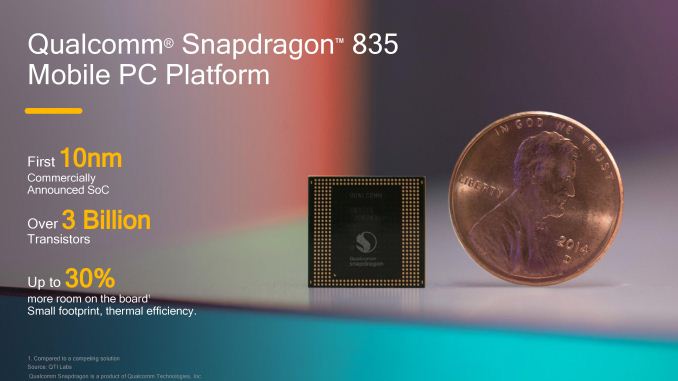
When we first heard about Windows on Snapdragon, we instantly thought that Qualcomm and Microsoft would be going after the Chromebook market but the announcement today is clear that both companies are going for something a bit more substantial along with all-day battery life. The official press release states that ‘Sleek, thin and fanless PCs running a Windows 10 experience’, with the 10nm SoC, sounds something more than a basic Chromebook.

One might suggest that the Snapdragon 835 is a premium SoC, and Qualcomm certainly wants to promote their hardware in high-end premium devices. With Snapdragon 835 in high-end smartphones, one of the elements Qualcomm is promoting is the fact that their SoC solution has a smaller PCB footprint: OEMs can use the extra space and weight for extra battery. This is part of the story which Qualcomm states allowing a ‘truly always on’ device such that updates can run in the background when the system is in sleep modes.

Part of the demonstrations at the Computex show floor, Qualcomm was showing Windows 10 being used with UWP applications but also some non-UWP apps being used, such as 7-zip. The OS element is something we’re likely to hear during Microsoft’s announcements during the week, which I feel might be a tipping point for these sorts of platforms. I’ve been using the MateBook X this week during Computex, and the battery life is actually fairly decent for an 1800 Euro ultraportable with a 15W CPU: but there’s still a small amount of battery anxiety for sure, especially during network use. Qualcomm’s value-add is their baseband experience, which they say is a big plus on this new platform.

Having a proper productivity device is a plus, but big questions still surround performance, especially when emulating x86. It’s a problem that has been tackled and failed several times before. The Qualcomm issue here is somewhat smaller than previous attempts, because as far as we understand it only has to target Windows 10, and they’ve worked directly with Microsoft in order to support it. Qualcomm and Microsoft say that this combination is now a solved problem with minimal overhead.

The carousel image at the top shows the S835 compared to a 14nm equivalent, showing the 'board space' savings of up to 30%. Qualcomm is keen to point out that a competitor's platform will need things like M.2 in order to add storage, which they say also take up board space compared to a Qualcomm solution.

Footprints

As part of our briefing, Qualcomm showed off an example reference PCB design that might go into the devices that they are targeting. 

On the left is an Intel solution, with on the right being from Qualcomm: 96.1cm2 compared to 50.4cm2 respectively. Here's a closer image of the Qualcomm solution (click through for high resolution):

The SoC is on the top right, with storage and memory to the left. It's worth noting on the far right is a USB Type-C connection, which would be the power input as well as how to connect other devices. There is no SIM card, as Qualcomm is integrated a multi-region eSIM which is activated at the time of purchase.


Read the full article here by AnandTech Article Channel

Nest Cam IQ is a $300 indoor camera with a 6-core processor


reader comments 0

Nest is adding a third camera to its lineup, after the

Nest Cam

and

Nest Cam Outdoor

. The new Nest Cam IQ occupies a premium spot over the other two, and it is an indoor-only $300 "sort-of 4K" camera.

I say "sort-of 4K" because the Nest Cam IQ does have a 4K (8MP) sensor, but to reduce storage and wireless data needs, it only records in 1080p. The 4K sensor is used for a digital zoom feature, and with a fancy cloud-powered "enhance!" mode, Nest is promising a "12x digital zoom." Zooming happens automatically when the Nest Ca IQ detects a person, at which point the camera will start saving two video streams, one at full crop and one zoomed in. Recording two video streams at once means the IQ is doing a significant amount of on-board processing, which is powered by a surprisingly beefy six-core Qualcomm processor.

The camera is Wi-Fi-only—there's no ethernet. Power is supplied by a USB-C cord and a power brick. You can't record anything locally—recording on the Nest Cam IQ requires a monthly subscription to Nest Aware. The subscription service has two tiers: a 10-day video history or a 30-day video history. The 10-day plan is $10 a month (or $100 a year) for the first camera and $5 a month (or $50 a year) for the second camera. The 30-day plan is $30 a month (or $300 a year) for the first camera and $15 a month (or $150 a year) for the second camera. There is absolutely no ability to record video without the monthly fee, though you can view pictures from the last three hours, and the camera will still send you alerts.

Nest Aware also gets you activity zones and cloud-compute-powered person detection. The person detection isn't just "any generic person," but it actually uses facial recognition and can determine "familiar" faces from strangers. A battery of IR LEDs allows the camera to see in the dark, and a speaker and microphone are setup for two-way voice interaction. Nest says the speaker is "7x more powerful than the original Nest Cam." There's also "Intelligent audio alerts," which can automatically detect and alert you of a dog barking or someone talking.

Nest is particularly proud of the design elements of the camera. The cord is in the base, so the power wires somehow survive being housed in a cup-and-ball hinge with a surprising range of motion. The USB-C wire is a custom design that sits flush inside the base of the unit, and the power "brick" is more a lovingly-designed marshmallow. The camera itself looks familiar—it's the Nest Cam Outdoor design on a stick. The base also has a standard tripod thread on the bottom, making it easy to wall mount.

In the US, the Nest Cam IQ​ is up for preorder now at $299 for one camera or $498 for a two-pack. In the UK, France, Netherlands, Belgium, and the Republic of Ireland, the Cam IQ "will be available for preorder" (does that mean today?) for €349/£299. Preorders for Germany, Austria, Italy, and Spain start June 13. Shipping is expected everywhere by the "end of June."

As usual, the nearly-mandatory subscription plan means Nest is shipping a camera with one of the highest total-costs-of-ownership on the market, but the cloud platform and app means it's also the smartest and easiest-to-use. Does that make the IQ worth it?

Listing image by Ron Amadeo


Read the full article here by Ars Technica