Friday, 1 December 2017

Qt 3D Studio 1.0 Released, Powered By NVIDIA's Open-Source Code

The Qt Company is today shipping Qt 3D Studio, its new 3D user-interface authoring system for both developers and designers.

Qt 3D Studio 1.0 has a Studio Editor for creating interactive 3D presentations and applications, the Qt 3D Studio Viewer for testing new 3D designs in action, and is supported across Windows / macOS / Linux.

Of course, this new 3D Studio is powered by the Qt5 tool-kit. This new software package is made possible and based upon

NVIDIA's huge code contribution

to Qt earlier this year of opening the NVIDIA DRIVE Design Studio that became the basis for Qt 3D Studio.

Looking ahead to next year, The Qt Company has already been

planning greater improvements to Qt 3D Studio

including the replacement of NVIDIA's renderer/runtime with a new Qt 3D renderer, better hardware/OS support, and more.

More details on today's Qt 3D Studio 1.0 release via

The Qt Blog

.


Read the full article here by Phoronix

Thursday, 30 November 2017

Google launches Datally for Android, a tool to monitor and control mobile data usage

For many people -- particularly in certain parts of the world -- mobile data is an expensive commodity. If you're someone who likes to keep an eye on exactly what's using up all of your allowance -- and take control of it -- Google's new Android app, Datally, can help. Datally has been designed to not only reveal which apps are using up data, but to provide a way to rein it in. Formerly known as Triangle whilst in beta, the app lets you block background data usage on a per-app basis, and makesit much easier to access data-related settings.… [Continue Reading]


Read the full article here by Betanews

Monday, 27 November 2017

Why ESR Hates C++, Respects Java, and Thinks Go (But Not Rust) Will Replace C

Open source guru Eric S. Raymond followed up his post on alternatives to C by explaining why he won't touch C++ any more, calling the story "a launch point for a disquisition on the economics of computer-language design, why some truly unfortunate choices got made and baked into our infrastructure, and how we're probably going to fix them." My problem with [C++] is that it piles complexity on complexity upon chrome upon gingerbread in an attempt to address problems that cannot actually be solved because the foundational abstractions are leaky. It's all very well to say "well, don't do that" about things like bare pointers, and for small-scale single-developer projects (like my eqn upgrade) it is realistic to expect the discipline can be enforced. Not so on projects with larger scale or multiple devs at varying skill levels (the case I normally deal with)... C is flawed, but it does have one immensely valuable property that C++ didn't keep -- if you can mentally model the hardware it's running on, you can easily see all the way down. If C++ had actually eliminated C's flaws (that is, been type-safe and memory-safe) giving away that transparency might be a trade worth making. As it is, nope. He calls Java a better attempt at fixing C's leaky abstractions, but believes it "left a huge hole in the options for systems programming that wouldn't be properly addressed for another 15 years, until Rust and Go." He delves into a history of programming languages, touching on Lisp, Python, and programmer-centric languages (versus machine-centric languages), identifying one of the biggest differentiators as "the presence or absence of automatic memory management." Falling machine-resource costs led to the rise of scripting languages and Node.js, but Raymond still sees Rust and Go as a response to the increasing scale of projects. Eventually we will have garbage collection techniques with low enough latency overhead to be usable in kernels and low-level firmware, and those will ship in language implementations. Those are the languages that will truly end C's long reign. There are broad hints in the working papers from the Go development group that they're headed in this direction... Sorry, Rustaceans -- you've got a plausible future in kernels and deep firmware, but too many strikes against you to beat Go over most of C's range. No garbage collection, plus Rust is a harder transition from C because of the borrow checker, plus the standardized part of the API is still seriously incomplete (where's my select(2), again?). The only consolation you get, if it is one, is that the C++ fans are screwed worse than you are. At least Rust has a real prospect of dramatically lowering downstream defect rates relative to C anywhere it's not crowded out by Go; C++ doesn't have that.
Share on Google+

Read more of this story at Slashdot.


Read the full article here by Slashdot

Sunday, 26 November 2017

Intel: We've Found Severe Bugs in Secretive Management Engine, Affecting Millions

Liam Tung, writing for ZDNet: Thanks to an investigation by third-party researchers into Intel's hidden firmware in certain chips, Intel decided to audit its firmware and on Monday confirmed it had found 11 severe bugs that affect millions of computers and servers. The flaws affect Management Engine (ME), Trusted Execution Engine (TXE), and Server Platform Services (SPS). Intel discovered the bugs after Maxim Goryachy and Mark Ermolov from security firm Positive Technologies found a critical vulnerability in the ME firmware that Intel now says would allow an attacker with local access to execute arbitrary code. The researchers in August published details about a secret avenue that the US government can use to disable ME, which is not available to the public. Intel ME has been a source of concern for security-minded users, in part because only Intel can inspect the firmware, yet many researchers suspected the powerful subsystem had bugs that were ripe for abuse by attackers.
Share on Google+

Read more of this story at Slashdot.


Read the full article here by Slashdot

140° - SSD Samsung Série 850 EVO, 500 Go, SATA III

SSD externe Samsung 500gb
129,18e au lieu de 189,90e avec le code : BLACKSALES

Fdp gratuit en relais colis.

SSD - C...

Read the full article here by Dealabs

Google adds Fuchsia support to Apple's Swift

Google's in-development operating system, named 'Fuchsia,' first appeared over a year ago. It's quite different from Android and Chrome OS, as it runs on top of the real-time 'Magenta' kernel instead of Linux. According to recent code commits, Google is working on Fuchsia OS support for the Swift programming language. There's a tiny error in this summary form AndroidPolice - Fuchsia's kernel has been renamed to Zircon. All this has been playing out late last week and over the weekend - Google is now working on Swift, and some took this to mean Google forked Apple's programming language, while in reality, it just created a staging ground for Google to work on Swift, pushing changes upstream to the official Swift project when necessary - as confirmed by Chris Lattner, creator of Swift, who used to work at Apple, but now works at Google. Zac Bowling, a Google engineer working on Fuchsia, then highlighted a pull request that Google pushed to the main Swift repository: Swift support for Fuchsia. He also mentioned a few upcoming pull requests: FYI, in the pipeline after this we will have some PRs related to: adding ARM64 support for the Fuchsia SDK fixing cross-compiling issues for targeting BSD, Linux and Fuchsia targets from a Darwin toolchain adding support for using lld for linking specific SDK stdlibs (part of getting a Darwin toolchain capable of cross compiling to other targets) supporting unit tests on Fuchsia Regarding Fuchsia's purpose, this is yet another little puff of smoke. Sadly, we still haven't found the fire.

Read the full article here by OSNews

The Last of the Iron Lungs

Sunday, 19 November 2017

Intel Planning To End Legacy BIOS Support By 2020

Intel is planning to end "legacy BIOS" support in their new platforms by 2020 in requiring UEFI Class 3 or higher.

Making rounds this weekend is a slide deck from the recent UEFI Plugfest. Brian Richardson of Intel talked about the "last mile" barriers to removing legacy BIOS support from systems.

By 2020, they will be supporting no less than UEFI Class 3, which means only UEFI support and no more legacy BIOS or CSM compatibility support mode. But that's not going to force on UEFI Secure Boot unconditionally: Secure Boot enabled is considered UEFI Class 3+.

Intel hasn't removed legacy BIOS / CSM support yet due to many customers' software packages still relying upon legacy BIOS, among other reasons. Removing the legacy BIOS support will mitigate some security risks, needs less validation by vendors, allows for supporting more modern technologies, etc.

By 2020 they are said to be "removing legacy BIOS support from client and data center platforms." Based on the timing, it's then looking like for Intel Tiger Lake or Sapphire Rapids where they may cut off the legacy BIOS support.

More details via

this slide deck

.


Read the full article here by Phoronix

Thursday, 16 November 2017

Visual Studio Live Share gives you pair programming without the shared keyboards

(PR) VESA Rolls Out DisplayID Version 2.0

Python in Unreal Engine 4

While Autodesk University might seem like too much of a manufacturing kind of thing for most game developers, a lot of game companies actually take part in this initiative. Just a couple of hours ago we’ve received a little email from Epic Games, giving a little glimpse of using Python and Blueprints in Unreal Engine for the purpose of data preparation. The piece is published by Ken Pimentel, the senior product manager at Epic.

Where we need to go

To get to a truly frictionless workflow, we also have to address issues of automating and preparing data for real-time use. We can’t always expect data pushed through Datasmith to be “render perfect” or “optimized,” so we have to provide some means of addressing these kinds of issues in a non-destructive manner (meaning you can easily make changes to the upstream data without repeating work you’ve already done).

 PythonInUnreal_1.jpg

Traditional workflows to get data ready for the Unreal Engine rely on other tools to optimize the data.

The future revealed

This week at Autodesk University, for the first time we’re showing an early preview of using Python and Blueprints in Unreal Engine for the purpose of data preparation.
 
PythonInUnreal_2.jpg

 Future workflows to get data ready will use Datasmith and Unreal Engine-based tools.

The demo provides a quick window into the possibilities when users have the option of working in Python and/or Epic’s Blueprint Visual Scripting to take advantage of new, sophisticated data preparation tools that process and optimize scene data. Data prep functions we’re exploring range from “find all parts smaller than 1 cubic centimeter and decimate them” to “find these objects and automatically repair them (fixing bad topology, gaps and overlaps).”

PythonInUnreal_3.jpg

 In this example, the motorcycle is processed with a series of simple rules that create a more optimized version.

You can find the full post over here.


© kikundra for 80lvl, 2017. | Permalink | No comment | Add to del.icio.us
Post tags: , ,

Feed enhanced by Better Feed from Ozh


Read the full article here by 80lvl

Wednesday, 15 November 2017

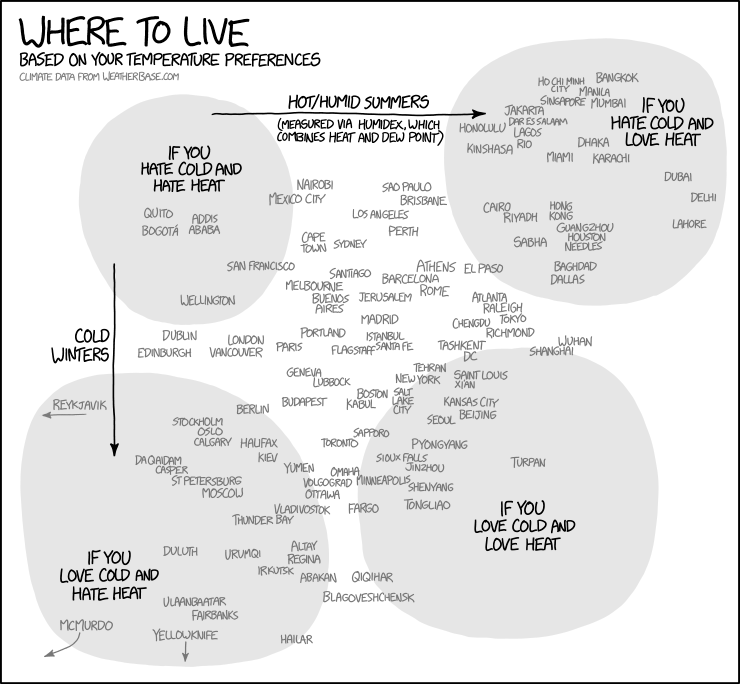
Temperature Preferences

There's a supposed Mark Twain quote, "The coldest winter I ever spent was a summer in San Francisco." It isn't really by Mark Twain, but I don't know who said it—I just know they've never been to McMurdo Station.

Read the full article here by xkcd.com

OnePlus left a backdoor in its devices with root access

Just a month ago, OnePlus was caught collecting personally identifiable data from phone owners through incredibly detailed analytics. While the company eventually reversed course on the data collection, another discovery has been made in the software of OnePlus phones. One developer found an application intended for factory testing, and through some investigation and reverse-engineering, was able to obtain root access using it. People often tout OnePlus phones as an alternative to the Pixel line now that Google abandoned the Nexus concept of affordable, high-quality phones. Recent events, however, have made it very clear that you should really steer clear of phones like this, unless you know very well what you're doing.

Read the full article here by OSNews

Tuesday, 14 November 2017

There are over a billion outdated Android devices in use

How out of date are android devices? It’s common knowledge that Android device tend to be more out of date than iOS devices, but what does this actually mean? Let’s look at android marketshare data to see how old devices in the wild are. The x axis of the plot below is date, and the y axis is Android marketshare. The share of all devices sums to 100% (with some artifacts because the public data Google provides is low precision).

Color indicates age:

  • blue: current (API major version)
  • yellow: 6 months
  • orange: 1 year
  • dark red: 2 years
  • bright red/white: 3 years
  • light grey: 4 years
  • grey: 5 years
  • black: 6 years or more

If we look at the graph, we see a number of reverse-S shaped contours; between each pair of contours, devices get older as we go from left to right. Each contour corresponds to the release of a new android version and the associated devices running that android version. As time passes, devices on that version get older. When a device is upgraded, they’re effectively removed from one contour into a new contour and the color changes to a less outdated color.

There are three major ways in which this graph understates the number of outdated devices:

First, we’re using API version data for this and don’t have access to the marketshare of point releases and minor updates, so we assume that all devices on the same API version are up to date until the moment a new API version is released, but many (and perhaps most) devices won’t receive updates within an API version.

Second, this graph shows marketshare, but the number of Android devices has dramatically increased over time. For example, if we look at the 80%-ile most outdated devices (i.e., draw a line 20% up from the bottom), it the 80%-ile device today is a few months more outdated than it was in 2014. The huge growth of Android means that there are many many more outdated devices now than there were in 2014.

Third, this data comes from scraping Google Play Store marketshare info. That data shows marketshare of devices that have visited in the Play Store in the last 7 days. In general, it seems reasonable to believe that devices that visit the play store are more up to date than devices that don’t, so we should expect an unknown amount of bias in this data that causes the graph to show that devices are newer than they actually are.

One thing we can see from that graph is that, as time goes on, the world accumulates a larger fraction of old devices over time. This makes sense and we could have figured this out without looking at the data. After all, back at the beginning of 2010, Android phones couldn’t be much more than a year old, and now it’s possible to have Android devices that are nearly a decade old.

Something that wouldn’t have been obvious without looking at the data is that the uptake of new versions seems to be slowing down – we can see this by looking at the last few contour lines at the top right of the graph, corresponding to the most recent Android releases. These lines have a shallower slope than the contour lines for previous releases. Unfortunately, with this data alone, we can’t tell why the slope is shallower. Some possible reasons might be:

  • Android growth is slowing down
  • Android device turnover (device upgrade rate) is slowing down
  • Fewer devices are receiving updates

Without more data, it’s impossible to tell how much each of these is contributing to the problem. BTW, let me know if you know of a reasonable source for the active number of Android devices going back to 2010! I’d love to produce a companion graph of the total number of outdated devices.

But even with the data we have, we can take a guess at how many outdated devices are in use. In May 2017, Google announced that there are over two billion active Android devices. If we look at the latest stats (the far right edge), we can see that nearly half of these devices are two years out of date. At this point, we should expect that there are more than one billion devices that are two years out of date! Given Android’s update model, we should expect approximately 0% of those devices to ever get updated to a modern version of Android.

Percentiles

Since there’s a lot going on in the graph, we might be able to see something if we look at some subparts of the graph. If we look at a single horizontal line across the graph, that corresponds to the device age at a certain percentile:

Over time, the Nth percentile out of date device is getting more out of date

In this graph, the date is on the x axis and the age in months is on the y axis. Each line corresponds to a different percentile (higher percentile is older), which corresponds to a horizontal slice of the top graph at that percentile.

Each individual line seems to have two large phases (with some other stuff, too). There’s one phase where devices for that percentile get older as quickly as time is passing, followed by a phase where, on average, devices only get slightly older. In the second phase, devices sometimes get younger as new releases push younger versions into a certain percentile, but this doesn’t happen often enough to counteract the general aging of devices. Taken as a whole, this graph indicates that, if current trends continue, we should expect to see proportionally more old Android devices as time goes on, which is exactly what we’d expect from the first, busier, graph.

Dates

Another way to look at the graph is to look at a vertical slice instead of a horizontal slice. In that case, each slice corresponds to looking at the ages of devices at one particular date:

In this plot, the x axis indicates the age percentile and the y axis indicates the raw age in months. Each line is one particular date, with older dates being lighter / yellower and newer dates being darker / greener.

As with the other views of the same data, we can see that Android devices appear to be getting more out of date as time goes on. This graph would be too busy to read if we plotted data for all of the dates that are available, but we can see it as an animation:

iOS

For reference, iOS 11 was released two months ago and it now has just under 50% iOS marketshare despite November’s numbers coming before the release of the iPhone X (this is compared to < 1% marketshare for the latest Android version, which was released in August). It’s overwhelmingly likely that, by the start of next year, iOS 11 will have more than 50% marketshare and there’s an outside chance that it will have 75% marketshare, i.e., it’s likely that the corresponding plot for iOS would have the 50%-ile (red) line in the second plot at age = 0 and it’s not implausible that the 75%-ile (orange) line would sometimes dip down to 0. As is the case with Android, there are some older devices that stubbornly refuse to update; iOS 9.3, released a bit over two years ago, sits at just a bit above 5% marketshare. This means that, in the iOS version of the plot, it’s plausible that we’d see the corresponding 99%-ile (green) line in the second plot at a bit over two years (half of what we see for the Android plot).

Conclusion

We’ve seen that Android devices appear to be getting more out of date over time. This makes it difficult for developers to target “new” Android API features, where new means anything introduced in the past few years. It also means that there are a lot of Android devices out there that are behind in terms of security. This is true both in absolute terms and also relative to iOS.

Until recently, Android was directly tied to the hardware it ran on, making it very painful to keep old devices up to date because that requiring a custom Android build with phone-specific (or at least SoC-specific work). Google claims that this problem is fixed in the latest Android version (8.0, Oreo). People who remember Google’s “Android update alliance” annoucement in 2011 may be a bit skeptical of the more recent annoucement. In 2011, Google and U.S. carries announced that they’d keep devices up to date for 18 months, which mostly didn’t happen. However, even if the current annoucement isn’t smoke and mirrors and the latest version of Android solves the update probem, we’ve seen that it takes years for Android releases to get adopted and we’ve also seen that the last few Android releases have significantly slower uptake than previous releases. Additionally, even though this is supposed to make updates easier, it looks like Android is still likely to stay behind iOS in terms of updates for a while. Google has promised that its latest phone (Pixel 2, 10/2017) will get updates for three years. That seems like a step in the right direction, but as we’ve seen from the graphs above, extending support by a year isn’t nearly enough to keep most Android devices up to date. But if you have an iPhone, the latest version of iOS (released 9/2017) works on devices back to the iPhone 5S (released 9/2013).

If we look at the newest Android release (8.0, 8/2017), it looks like you’re quite lucky if you have a two year old device that will get the latest update. The oldest “Google” phone supported is the Nexus 6P (9/2015), giving it just under two years of support.

If you look back at devices that were released around when the iPhone5S, the situation looks even worse. Back then, I got a free Moto X for working at Google; the Moto X was about as close to an official Google phone as you could get at the time (this was back when Google owned Moto). The Moto X was released on 8/2013 (a month before the iPhone 5S) and the latest version of Android it supports is 5.1, which was released on 2/2015, a little more than a year and a half later. For an Android phone of its era, the Moto X was supported for an unusually long time. It’s actuall a good sign that things look worse as look further back in time, but at the rate things are improving, it will be years before there’s a decently supported Android device released and then years beyond those years before that Android version is in widespread use. It’s possible that Fuchsia will fix this, but Fucshia is also many years away from widespread use.

In a future post, we’ll look at Android response latency is also quite interesting. It’s much more variable between phones than iOS response latency is between different models of iPhone.

The main thing I’m missing from my analysis of phone latency is older phones. If you have an old phone I haven’t tested and want to donate it for testing, you can mail it to:

Dan Luu
Recurse Center
455 Broadway, 2nd Floor
New York, NY 10013

Thanks to Leah Hanson, Kate Murphy, Marek Majkowski, @zofrex, @Aissn, Chris Palmer, and an anonymous person for comments/corrections/related discussion.

Also, thanks to Victorien Villard for making the data these graphs were based on available!


Read the full article here by Dan Luu

Mercedes' ubiquitous city bus is going electric in 2018

Mercedes-Benz wants an electric version of its long-running city bus to power the emissions-free mass transit future. Over a dozen cities recently pledged to make their bus fleets all-electric by 2030 (among them LA and Seattle). And, if the German auto-maker gets its way, its EV will be the one ferrying people around all hours of the day. Mercedes announced that it plans to start producing the electric "Citaro" by the end of 2018.

In the meantime, it's begun testing prototypes in "extreme" conditions, like the icy roads of the Arctic circle and on the sweltering tarmac in Spain's Sierra Nevada. The move comes just days after its parent company Daimler unveiled its electric school bus, further emphasizing its commitment to electric public transportation.

The "ultra quiet" bus is powered by modular, lithium-ion battery packs that fuel the electric wheel hub motors at the rear axle. The company also touts its energy-efficient climate control system as a range booster. But, it will have its work cut out to beat EV manufacturer Proterra -- which recently set the record for longest distance traveled by an electric bus on a single charge (a whopping 1,101.2 miles). It's also facing competition from Navya, the French firm behind the Las Vegas driverless shuttle service that just started back up (albeit with a hiccup). Not to mention household names like Volvo and Toyota.

Source: Daimler


Read the full article here by Engadget

Germany's future trains have digital cars with game consoles

The impending era of driverless rides could prove disruptive for traditional modes of public transport. But, Germany's state-owned railway company thinks it has a solution, and it sounds like a lot of fun -- especially for gamers. It just unveiled plans for a new train complete with a digital coach that packs TVs and game consoles. Deutsche Bahn's "Ideenzug" ("Idea Train") will also boast gym equipment and a play area for kids. The railway firm envisions the project as a way to keep pace with, and even overtake, self-driving cars. (If it thinks autonomous vehicles are a scary prospect, wait till it learns of the Hyperloop).

For people turned off by backward-facing chairs, the train will boast swivelling seats (some of which will also come with bulges on either side for added privacy). Deutsche Bahn is currently showing off a replica of the project. But, making it a reality could prove a tricky prospect, with some claiming that it may not pass security regulations, as reported by German newspaper Süddeutsche Zeitung. The sticking point seems to be the gym equipment, so gaming will likely still be on the cards.

Railway travel is changing elsewhere too, but these modifications have hinged on green energy and faster journeys. India, for example, recently debuted a solar-powered train, while Japan is known for its high-speed bullet trains. But, Deutsche Bahn's project seems retrofitted to accommodate the modern-day traveller. Someone who wants to get in a workout, catch up on work, and indulge in some multiplayer action en route to their destination. All that's missing is Netflix.

Source: Deutsche Bahn


Read the full article here by Engadget

Quantum-ized Firefox 57 Ready For Download

Firefox 57.0 is being officially released this week and its stable download is now available...

Read the full article here by Phoronix

Qualcomm rejects Broadcom’s buyout bid

Last week, wireless chip manufacturer Broadcom made a $130 billion bid to buy out rival Qualcomm. The unsolicited proposal was expected to be rejected by Qualcomm, and as of this morning, it has been. The company's board of directors unanimously voted against Broadcom's bid saying that it undervalued Qualcomm.

"It is the board's unanimous belief that Broadcom's proposal significantly undervalues Qualcomm relative to the company's leadership position in mobile technology and our future growth prospects," Paul Jacobs, Qualcomm's chairman of the board, said in a statement. Qualcomm CEO Steve Mollenkopf added that the company's technology -- its 5G tech in particular -- puts it in a position to generate additional value for stockholders beyond what Broadcom's bid suggests, and Qualcomm's director, Tom Horton said, "We are highly confident that the strategy Steve and his team are executing on provides far superior value to Qualcomm shareholders than the proposed offer."

This is unlikely to be the end of the attempted takeover, however. Sources told Reuters that prior to Qualcomm's official rejection, Broadcom was already considering a larger bid. It was also exploring the possibility of putting the decision in the shareholders' hands by nominating individuals to Qualcomm's board who would engage with negotiation talks. If shareholders are more open to the buyout than the current board is, they would then have the option of voting in new members who are more supportive of the deal.

Source: Qualcomm


Read the full article here by Engadget